Integrating Leopard Print Round Christmas Graphics into Your Creative Workflow
The holiday season presents a unique challenge for designers, small business owners, and DIY enthusiasts: balancing the demand for festive aesthetics with the need for operational efficiency. In this context, digital assets like Leopard Print Round Christmas Graphic elements serve as more than just decorative images; they are functional components of a streamlined production pipeline. By incorporating high-quality, versatile clip art into your planning phase, you can reduce design time, ensure brand consistency across multiple touchpoints, and accelerate the transition from concept to physical product.
This article explores how to effectively integrate these specific graphic resources into your existing workflows. We will examine preparation strategies, compatibility considerations, and practical applications for both digital and physical outputs, ensuring that your holiday projects are executed with precision and professional quality.
Asset Preparation and File Management
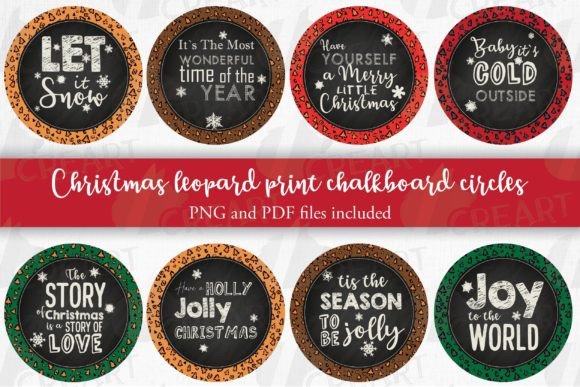
Successful implementation begins before you open your design software. The Christmas circles leopard print chalkboard cards clip art pack is structured to support various stages of production, but realizing its full potential requires organized file management. Upon purchase, you receive a comprehensive package containing eight distinct high-resolution PNG images, each dimensioned at 11x11 inches. Additionally, the pack includes eight mirrored 4x4 inch PNGs specifically optimized for transfer projects, two letter-size ready-to-print PNGs, and one PDF file.
To maintain efficiency, establish a dedicated folder structure on your local drive or cloud storage immediately after download. Separate the files by their intended use case. For instance, keep the 11x11 inch graphics in a folder labeled "General Design & Web," while isolating the 4x4 inch mirrored images in a folder labeled "Transfer & Coasters." This segregation prevents confusion during high-volume production periods when quick access to the correct file format is critical.
It is also essential to verify the integrity of the files upon receipt. Although the provider guarantees no watermarks on purchased items, performing a quick visual check ensures that the transparency layers in the PNG files are intact. This step is crucial for maintaining clean edges when placing individual clipart on varying backgrounds, a common requirement in professional design work.
Digital Integration and Web Design Applications
In the digital realm, the versatility of the Leopard Print Round Christmas Graphic allows for seamless integration into web design, email marketing, and social media campaigns. The high-resolution nature of the 11x11 inch PNGs ensures that these graphics remain crisp on retina displays and high-density screens. When incorporating these elements into website headers, blog post featured images, or promotional banners, consider the color theory implications of the leopard print pattern against your existing brand palette.
Because these are PNG files with transparent backgrounds, you can place the individual clipart on any color or background you like. This flexibility is particularly valuable for A/B testing different visual themes without needing to recreate assets from scratch. For example, you might test a dark charcoal background against a soft cream backdrop to see which yields higher engagement rates for your holiday newsletter. The ability to swap backgrounds rapidly accelerates the iteration process, allowing marketers and bloggers to respond quickly to performance data.
Furthermore, these graphics can enhance user experience by breaking up text-heavy content. Using the round Christmas graphics as bullet points or section dividers in long-form articles adds visual interest without distracting from the core message. This approach aligns with modern web design principles that prioritize readability and aesthetic cohesion.
Physical Production: Transfers and Sublimation Workflows
For entrepreneurs and hobbyists involved in physical product creation, the included 4x4 inch mirrored PNGs are designed specifically for heat transfer and sublimation processes. This segment of the workflow requires strict attention to technical details to ensure quality control. The term "mirrored" indicates that the image has been horizontally flipped, a necessary step for iron-on transfers to ensure the final design reads correctly on the fabric or substrate.
When preparing these files for drink coaster digital graphic for transfer or apparel, verify your printer settings. Sublimation printing, in particular, demands specific color profiles (usually CMYK or specific ICC profiles depending on the printer) to achieve accurate color reproduction. The leopard print pattern, with its intricate details and contrast, serves as an excellent test case for calibrating your equipment. If the lines appear blurry or the colors shift significantly, adjust your printer resolution and ink levels before committing to a large batch.
Compatibility with various crafting programs is another key factor. Whether you are using Adobe Photoshop, Illustrator, Canva, or specialized cutting machine software like Cricut Design Space or Silhouette Studio, PNG formats are universally supported. However, layering these graphics with other elements requires careful handling. Ensure that the resolution remains at 300 DPI for print-ready outputs to avoid pixelation. The 4x4 inch dimensions are ideal for standard coasters, but if you are scaling up for larger items like pillows or wall decor, utilize the 11x11 inch versions to maintain clarity.
Print-on-Demand and Stationery Projects
The two letter-size ready-to-print PNGs and the included PDF file streamline the production of traditional printed materials such as Christmas printable cards, invitations, and scrapbooking elements. These assets are pre-formatted to fit standard paper sizes, reducing the need for manual layout adjustments. For small business owners offering custom stationery, this feature significantly reduces turnaround time.
When designing invitations or greeting cards, consider the tactile experience of the end user. The leopard print motif adds a touch of modern sophistication to traditional holiday themes. Pairing these graphics with high-quality cardstock and complementary typography can elevate the perceived value of the product. For decoupage projects, the clarity of the print ensures that the pattern remains distinct even when sealed with mod podge or varnish.
Additionally, these graphics are suitable for creating promotional materials. Small businesses can use the round graphics to design branded stickers, labels for packaging, or thank-you notes included with orders. Consistency in branding across these small touchpoints reinforces brand identity and enhances customer satisfaction. The ability to print these elements on-demand allows for inventory flexibility, reducing waste and storage costs associated with pre-printed materials.
Quality Control and Long-Term Usability
Integrating new assets into your workflow should not compromise quality standards. Establish a checklist for each project type to ensure consistency. For digital uses, check load times and visual alignment across different devices. For physical products, conduct spot checks on color accuracy, alignment, and material adhesion. The Christmas decoration elements should withstand the rigors of handling and display, so testing durability is essential for items like ornaments or coasters.
Long-term usability extends beyond the current holiday season. While the theme is Christmas-specific, the leopard print pattern itself is timeless. Consider how these assets can be repurposed or archived for future campaigns. Properly tagged and stored files can be retrieved quickly for next year’s planning, saving significant time in the subsequent design cycle. This forward-thinking approach to asset management contributes to overall operational efficiency and sustainability in creative practices.
By treating the Leopard Print Round Christmas Graphic pack as a strategic resource rather than just a collection of images, you can enhance your creative output, streamline production processes, and deliver high-quality results across both digital and physical platforms. The key lies in thoughtful preparation, technical precision, and consistent application within your established workflows.