Choosing the Right Handmade ECommerce Web Template UI Kit for Your Online Store
Launching an online store for handmade goods requires more than just a compelling product catalog; it demands a digital storefront that reflects the care, craftsmanship, and uniqueness of the items being sold. For designers and developers, starting from scratch can be time-consuming and costly. This is where a specialized Handmade ECommerce Web Template UI Kit becomes an invaluable resource. These kits provide a pre-designed foundation, allowing creators to focus on customization and functionality rather than reinventing the wheel. However, not all UI kits are created equal, and understanding what makes a specific kit suitable for the handmade niche is essential for making an informed decision.
Understanding the Value of a Specialized UI Kit
A UI (User Interface) kit is essentially a collection of design elements, components, and layouts that serve as the building blocks for a website. When tailored for handmade eCommerce, these kits often incorporate aesthetic choices that resonate with artisanal brands—such as warm color palettes, organic shapes, and typography that feels personal rather than corporate. The primary advantage of using a Handmade ECommerce Web Template UI Kit is efficiency. Instead of spending weeks designing individual buttons, product cards, and navigation bars, you can assemble a professional-looking interface in a fraction of the time.
Beyond speed, consistency is a major benefit. A well-structured kit ensures that every element, from the header to the footer, adheres to the same design language. This coherence builds trust with potential customers, who are more likely to purchase from a site that appears polished and professional. Furthermore, modern kits are designed with current trends in mind, ensuring that your store does not look outdated upon launch. The ability to modify the template simply allows even those with moderate design skills to tailor the look to their specific brand identity without needing advanced coding knowledge.
Key Features That Define Quality
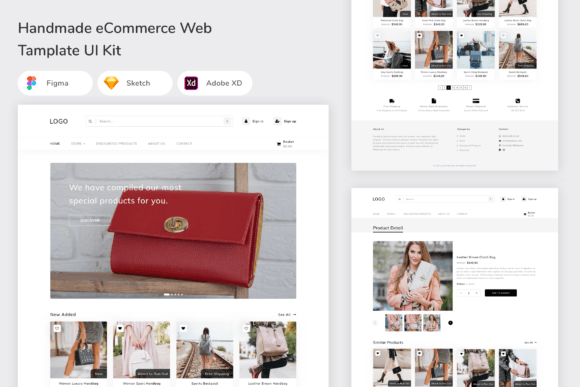
When evaluating a UI kit, several technical and design features stand out as indicators of quality and usability. First and foremost is compatibility with industry-standard design tools. A robust Handmade ECommerce Web Template UI Kit should offer files for Sketch, Figma, Adobe XD, and Adobe Photoshop. This flexibility ensures that regardless of your preferred workflow or team structure, you can integrate the kit seamlessly into your design process. Figma, for instance, has become a favorite for collaborative teams due to its cloud-based nature, while Adobe Photoshop remains a staple for detailed image editing and raster-based design work.
Another critical aspect is the organization of the file structure. High-quality kits feature well-layered and organized files with customizable layers, fonts, and colors. This means that changing the primary brand color or swapping out a font family is a straightforward task, rather than a tedious hunt through hundreds of unnamed layers. Pixel-perfect UI elements are also non-negotiable; they ensure that the design looks crisp and professional on various screen resolutions. Additionally, the inclusion of free fonts and icons reduces the need for external licensing, simplifying the legal and logistical aspects of web development.
The presence of customizable vector shapes is another significant advantage. With 100 customizable vector shapes included, designers can create unique illustrations or background elements that align with the handmade theme. These vectors can be scaled without losing quality, making them ideal for responsive designs that must look good on both mobile devices and large desktop monitors. High-quality screens provided in the kit serve as excellent references, showing how different components come together in real-world scenarios.
Comparing UI Kits to Custom Design and Generic Templates
Deciding whether to use a Handmade ECommerce Web Template UI Kit often involves comparing it against two other common approaches: hiring a designer for a fully custom build or using a generic, off-the-shelf website template. Each option has its strengths and tradeoffs.
Custom Design: Hiring a professional designer offers the highest level of uniqueness and tailoring. Every pixel is placed with your specific brand in mind. However, this approach is significantly more expensive and time-consuming. For small businesses or startups with limited budgets, the cost may be prohibitive. Moreover, if the designer is not experienced in eCommerce best practices, the resulting design might look beautiful but fail to convert visitors into buyers.
Generic Templates: Many website builders offer pre-made templates that are ready to use with minimal effort. While these are convenient, they often lack the specific aesthetic nuances required for handmade brands. They can feel impersonal or "cookie-cutter," which may detract from the story of craftsmanship that handmade sellers want to convey. Additionally, generic templates may not offer the same level of design flexibility or high-quality assets as a dedicated UI kit.
UI Kits: A specialized UI kit strikes a balance between these extremes. It provides a high degree of customization and professional quality at a lower cost than a full custom design. Unlike generic templates, UI kits give designers the raw materials to create something unique while still benefiting from pre-tested layouts and components. The key difference is that a UI kit is a design resource, not a final product. It requires some design effort to assemble, but this effort yields a more distinctive result than a plug-and-play template.
Best-Fit Situations and Limitations
A Handmade ECommerce Web Template UI Kit is an ideal choice for several scenarios. It is particularly well-suited for freelance designers who want to deliver high-quality work to clients quickly, agencies looking to streamline their workflow, and entrepreneurs with some design skills who want to maintain control over their brand’s visual identity. If you value having access to ongoing updates and new features, many premium kits offer lifetime access to improvements, ensuring that your design resources remain current with evolving web standards.
However, there are limitations to consider. Using a UI kit requires a basic understanding of design principles and the software tools mentioned earlier. If you have no experience with Figma, Sketch, or Adobe products, there will be a learning curve. Additionally, while the kit provides the visual components, it does not handle the backend functionality of an eCommerce store. You will still need a developer or a platform like Shopify, WooCommerce, or Squarespace to bring the design to life as a functioning website.
Another consideration is the potential for similarity. If a particular UI kit becomes very popular, there is a risk that other stores might use the same base elements. To mitigate this, it is crucial to leverage the customizable aspects of the kit—changing colors, fonts, and layouts—to create a distinct look. The inclusion of 100 customizable vector shapes and free icons provides ample opportunity for differentiation if used creatively.
Making an Informed Decision
When choosing a UI kit, consider your long-term goals and resources. Ask yourself: Do I have the design skills to customize this kit? Does the kit support the tools my team uses? Is the style aligned with my brand’s personality? Look for kits that emphasize modern design trends but also offer timeless elements that won’t quickly go out of style. The promise of continuous updates is a strong indicator of a provider’s commitment to quality, as it means you will not be stuck with obsolete design patterns.
It is also wise to review the documentation and support offered with the kit. Well-documented kits make the modification process simpler and less frustrating. Check if the layers are logically named and if the color styles are globally defined, as these features significantly ease the customization process. Finally, consider the community or user base around the kit. A popular kit with an active community can provide valuable tips, tutorials, and troubleshooting advice.
In conclusion, a Handmade ECommerce Web Template UI Kit is a powerful tool for creating a professional and appealing online store. It offers a middle ground between the high cost of custom design and the limitations of generic templates. By providing pixel-perfect elements, customizable options, and compatibility with major design tools, these kits empower creators to build unique digital experiences that highlight the beauty of handmade products. Whether you are a seasoned designer or a motivated entrepreneur, understanding the features and tradeoffs of these kits will help you choose the right resource for your project, ensuring that your online presence is as crafted and thoughtful as the products you sell.